The MVP is dead – to build intelligent products, you need MVLPs

Denne blogposten ble først publisert her.
AI is taking the world by storm, and companies are scrambling to leverage and exploit new capabilities that could radically transform their products, processes, and business models. But intelligent products are fundamentally different from other digital products, and building them requires new ways of thinking. A traditional digital product requires users to interact in order for anything to happen at all, whereas an intelligent product will anticipate and predict user needs and dramatically reduce the need for interaction. We have experienced firsthand, and observed from the sidelines, that it is almost impossible for companies to build such products using existing product development methodology. As a first step toward addressing the need for new methods, we introduce the concept of the Minimum Viable Learning Product (MVLP). This is born from the realization that in the age of intelligent products and automated cognition, a product is not viable if it is not capable of learning. In the final section of this article, we also provide some ideas for a practical approach to creating an MLVP.
Automating Cognition
It seems that we are finally taking real steps toward the promised future of intelligent machines. 2021 and 2022 saw the release of disruptive AI innovations and feats of engineering such as DALL-E, Cicero, ChatGPT, Stable Diffusion, Codex, AlphaCode, and more. These have all challenged us humans in an area where we have so far had the upper hand over AI: the solving of day-to-day cognitive and creative tasks.
Cognitive tasks solved by machines until recently have seemed somewhat trivial to humans. Sure, recognizing an image of a dog and classifying it with high accuracy is very useful, but it will hardly make most people feel like they are living in the Jetson age. But now, we can see the contours of a future where cognitive automation just might change our lives in fundamental ways.
AI has a significant potential for enhancing and replacing cognitive work, but only if we start thinking about how to develop products where the value proposition lies in automation
Some of these systems have already reached widespread adoption, helping people write code, doing kids’ homework for them, creating beautiful art and illustrations, and more. Regardless of whether these are steps towards artificial general intelligence or not, and with all the shortcomings of the current implementations, they have a significant potential for enhancing and replacing cognitive work; both in our personal and professional lives. In other words, we need to start thinking about how to develop products where the value proposition lies in automation instead of just digitalization.
But what is the difference between automation and digitalization, and – more importantly – why does it matter for how we develop products?
From physical to digital, from digital to intelligent
The digital revolution of the past decades has replaced large amounts of physical tasks with digital interaction. The result is that many people can now both fulfill the majority of their needs and perform the majority of their work by interacting with digital products.
But even with all these efficiency gains, people are busier than ever both in their personal and professional lives. And even knowledge workers who do their work while sitting down at a desk can feel exhausted after their workday ends. Part of the reason for this is that while digital tasks do not require much physical effort, they still require cognitive work. And there is a lot of cognitive work going on: 60% of the US labor force are considered knowledge workers, and there are approximately 1 billion knowledge workers in total across the globe.
Machines have been constructed for centuries to perform tasks and follow rules and schemas, but even the computers of today have very little in the way of even basic cognitive abilities that humans depend on in their day-to-day life. The main focus of product development has been to reduce friction by removing unnecessary information and deterministic actions on part of the user, but so far very little in reducing friction through unnecessary thinking (even though user experience designers try their best to mitigate technology shortcomings here).
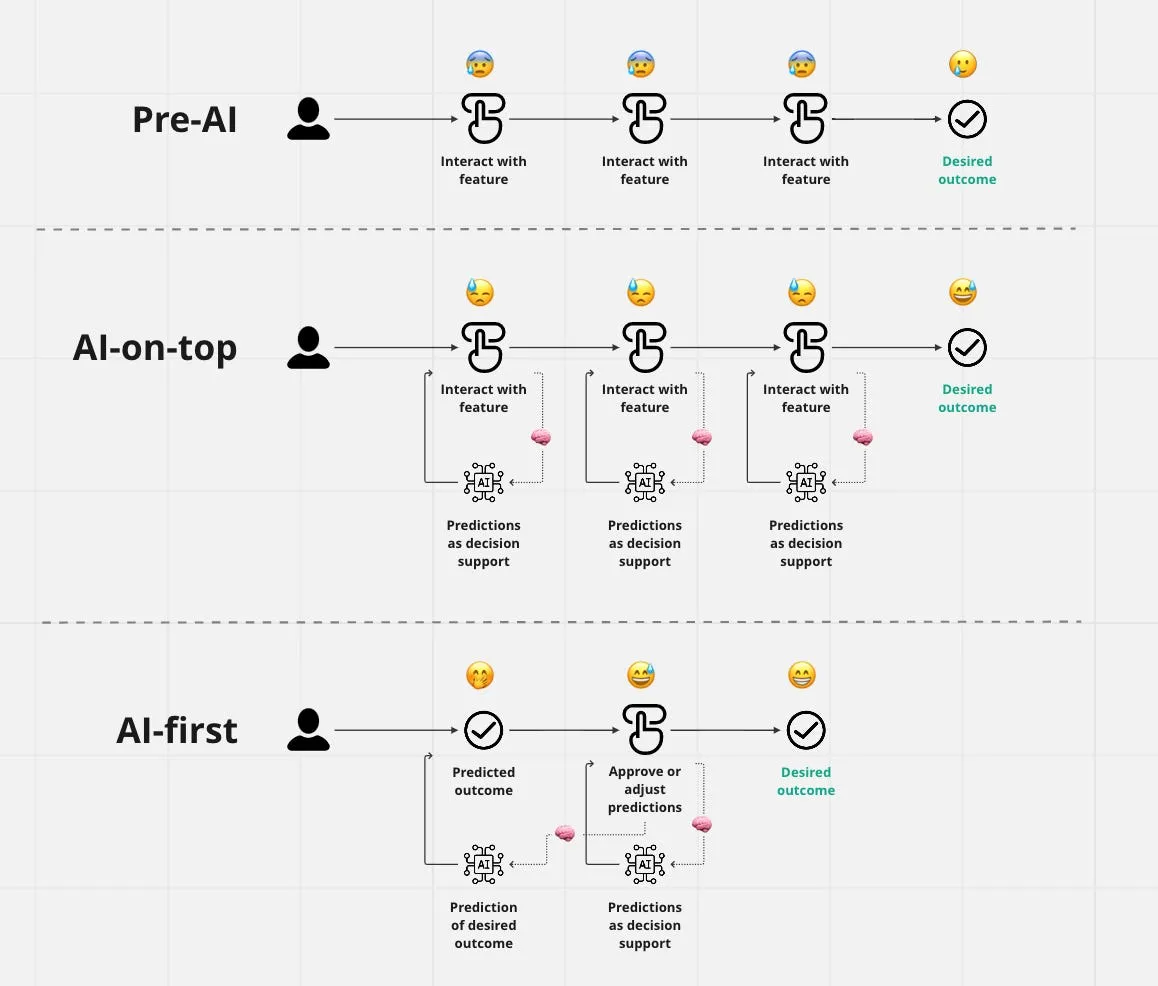
The companies surfing the next wave of disruption will be those that manage to adjust their strategies and build products that reduce user friction by removing unnecessary thinking
Given the recent advances in technologies that automate cognition and the vast demand for automating cognitive tasks, companies need to consider how they can gain competitive advantages by basing their own value proposition on cognitive automation. The truly groundbreaking products of tomorrow will be provided by the companies that are able to adjust – sometimes radically – their strategies, execution, and ways of working in order to unleash the full potential of AI in their value propositions and internal processes. Others may very well be facing their Kodak moment.
Building intelligent products
While setting the ambition is easy, actually building products that automate cognition is hard. We have experienced first-hand, and observed from the sidelines, that it is almost impossible for companies to build such products using existing product development methodology, especially on top of an existing solid digital product. We believe a shift in mindset is required; a shift in which companies stop thinking about digital products and start thinking about intelligent products.
Truly intelligent digital products don’t just happen by accident. Building them requires a company to be deliberate about a number of things, some of which are initially counter-intuitive and even seem contrary to the conventional wisdoms about product development and design that have served digital products so well. This is why it is critical to take a step back and reexamine everything a company is doing when a transformative technology like AI comes along.
Existing strategies and processes are not designed for products that can learn. This means there can be heuristics, mindsets, and ways of working in the organization that have served it well for building digital products, but that undermine efforts to build transformative intelligent products. The result is that most, if not all AI initiatives end up iterating around a local optimum of just “sprinkling some intelligence” on top of interactive workflows in existing products and processes.
David Bessis wrote about this back in 2018: “What makes pre-AI products so easy to build (and what makes the agile framework so successful) is the exact same thing that makes them hard to use: all the hard work is done by the users… AI-first products ‘..should just work’. But there is no well-established framework to build software products that just work.”
Put simply: The main pitfall is trying to build a cognitive product with methods developed for building interaction-based products, or even worse, attempting to rebuild an interaction-based product into a cognitive product with traditional product development methods. We, and many others, therefore recognize the need for building products AI-first using principles tailored to the task, and by all means, avoid bolting AI on top of existing interaction-based products.
It is critical to take a step back and reexamine everything a company is doing when a transformative technology like AI comes along.
So what is the alternative to the product development methods most companies are applying today? How do you develop an intelligent product that achieves an increasing degree of cognitive augmentation and automation?
The Minimum Viable Learning Product
While the difficulty in building intelligent products really needs to be addressed on many levels, we believe there is one idea that can help nudge a company out of this local optimum and get the ball rolling. It is not sufficient for transforming a digital company into an AI company on its own, but it can serve as a way to start demonstrating the value of cognitive automation, and as a springboard for having the right discussions and making more fundamental changes to the organization.
This is the idea of the MVLP; the Minimum Viable Learning Product. This is a product that is built with the minimum features it needs to learn to increasingly automate a desired outcome for users over time.
Many are familiar with the concept of a Minimum Viable Product – an MVP – which is an early version of a product that is deemed usable enough by users to achieve some outcome and provide feedback and validation for further product development. This approach in its vanilla form has some significant drawbacks if your end goal is to enable cognitive enhancement and/or automation toward that outcome.
The Minimum Viable Learning Product – a product with the minimum features it needs to learn to automate a desired outcome. If the goal is to automate cognition, a product is not viable unless it is capable of learning.
In the era of cognitive automation, it is not at all sufficient to validate that you can create a barebones, 100% interactive way to achieve the desired outcome. If you choose to do this, you will be at the mercy of user feedback that points to all the ways your interactive solution can be made better, as opposed to the implicit feedback your customers could be giving your algorithm about where it succeeded or failed to help them achieve their desired outcomes directly. Turning this ship after setting such a course is extremely hard.
Instead, the product needs to be designed and built around algorithms that learn and remove cognitive load instead of tacking algorithms on top of existing workflows (see illustration below for how you might see the difference). This means we can no longer aim to launch the traditional MVP, the Minimum Viable Product, and then build better interaction. We need to start building the MVLP – the Minimum Viable Learning Product - to start progressing toward cognitive automation.
An MVLP needs not only to be useful enough for a minimum number of users. It needs to be useful enough for a minimum number of users while learning to automate more and more over time. If you recognize that cognitive automation is the optimal way to deliver on your value proposition, and you are unable to build a product incorporating the feedback loops it needs to learn while being useful enough to have user interactions to learn from, you don’t have a competitive product in the long run. Simple as that.
Whether you’re a TikTok fan or detractor, the product serves as a good example of “algorithm-friendly design.” As Eugene Wei observed: “…the magic of the design of TikTok: it is a closed loop feedback loop which inspires and enables the creation and viewing of videos on which its algorithm can be trained. […] The entire screen is filled with one video. Just one. […] Everything you do from the moment the video begins playing is signal as to your sentiment towards that video.”
How to build an MVLP
Building an MVLP starts the same way as building an MVP: by recognizing the outcome that users want. This should be understood on the highest possible level within the scope of the value proposition and the constraints of the environment the company is operating within.
If you were building an MVP, the next step after this would probably be to do user research and create some sort of user journey representing the steps and interactions a user would have to go through and perform in order to achieve the outcome they want.
When building an MVLP, the next step will still be to do user research, but it will not be used primarily to inform the design of a user journey. Instead, what you want to do is understand and document the cognitive processes and mental models at play when humans solve for the desired outcome. You want to understand how people think rather than what they do, and what information they need to process rather than what tools they think they need.
Once you know the cognitive processes and the information they require, you can start translating the cognitive processes into prediction problems for AI to solve and the information requirements into data points for the AI to train on and use for making predictions.
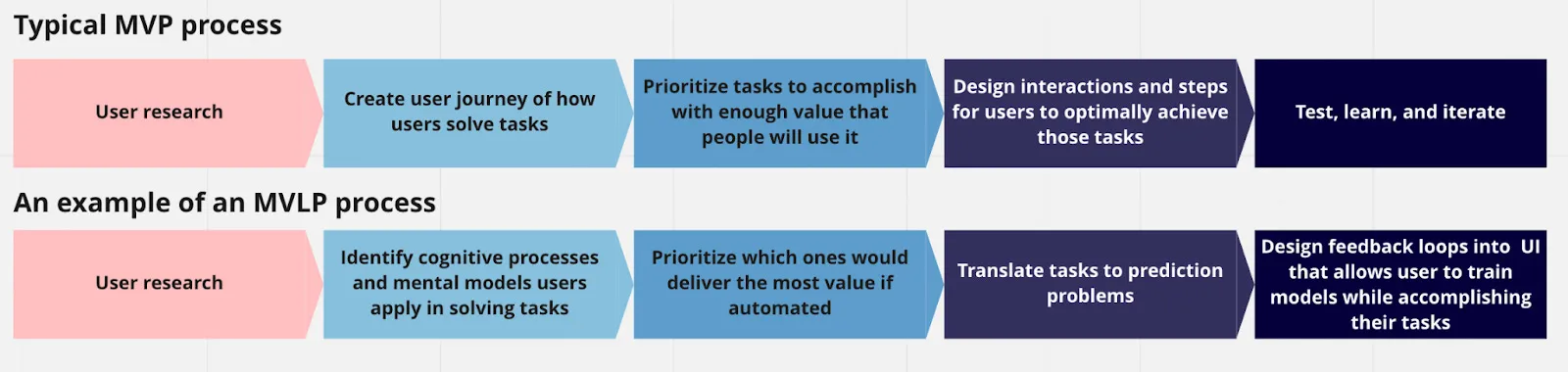
Building an MLVP starts with understanding human cognitive processes and translating them into AI prediction problems
Only now are you allowed to start thinking about what the user journey might look like. You still need to design and build a product that users will be interacting with and that is useful to them, but in such a fashion that everything the user does is with the purpose of getting the desired outcome while also providing as many data points as possible for the AI to learn to better solve the prediction problems you identified earlier. This ensures that every time somebody uses the product, the AI will do a better job the next time around; not just for that particular user but for all users, creating a very powerful flywheel effect.
Notice now how the user journey and the product manifest from both the requirements of the user and the requirements of the AI. This is absolutely essential to understand in order to build a truly intelligent product in the end. It is also important to recognize that this is no less user-focused than any other approach to product development. In fact, it is the most user-focused approach you can take because you are taking the best possible path from short-term usefulness for a minimum number of users toward long-term usefulness for your entire target audience.
It’s possible to argue that you don’t strictly need all this learning functionality from the get-go and that you can iterate and add learning features over time. While this has some truth to it, it’s likely to set your product development on the wrong course and make your solution less competitive in the long term. Remember that you are not really validating that your product works unless it is useful while also collecting the right data, and that data that is not collected is lost forever.
This all means that building MVLPs may take longer than building MVPs. But while the cost/benefit analysis may have come out in favor of the additional speed in the era of digitalization, we believe this is no longer true in the era of cognitive automation. Companies that sacrifice short-term gains and take the time to design the right product and collect the right data from the get-go stand to gain long-term competitive advantages that will be very hard – if not impossible – to catch up to for those that do not.
In summary, by adopting the MVLP approach companies can get the ball rolling on building intelligent products, and start nudging themselves out of their local optimum. This may require unlearning some heuristics and ways of working from the past, but that is always the case when new transformative technology comes around.
When more and more companies adopt this approach, they will discover that they can indeed stay relevant and competitive in this big tech-dominated era of rapid technological change, and we will start seeing the true potential of AI in all products and services.
Om forfatterne